Defensible space tree work in Ontario, CA means pruning and removing trees, shrubs and dead vegetation around a home so a wildfire or wind-blown embers have less fuel to carry fire to the house. CAL FIRE describes three zones: Zone 0 within 5 feet of the home, Zone 1 out to 30 feet and Zone 2 out to 100 feet. Whether your property is legally required to meet these rules depends on its fire hazard zone, so check that first. Call (909) 479-2614 to talk through your trees.
Who needs defensible space work
California's defensible space law applies to properties in certain fire hazard areas. Much of Ontario sits on the flat valley floor, and many lots are not in those zones, while foothill neighborhoods in nearby cities often are. You can look up your address on CAL FIRE's maps through its defensible space page. Even where it is not required, many Ontario owners choose fire-safe pruning because Santa Ana winds carry embers long distances and dry palm fronds and brush burn easily.
The three zones
CAL FIRE and the State Board of Forestry describe defensible space in zones measured out from the house:
- Zone 0, 0 to 5 feet. The ember-resistant zone. The goal is to keep anything that burns away from the walls, including dead leaves, wood mulch and branches over the roof.
- Zone 1, 5 to 30 feet. The lean, clean and green zone. Dead plants and branches are removed, trees are pruned away from the house and other trees, and plants are spaced to break up fuel.
- Zone 2, 30 to 100 feet. The reduced-fuel zone, out to the property line if that comes first. Dry grass is kept low, dead material is removed and trees and shrubs are spaced with gaps between them.
Tree work in each zone
Most of what homeowners need from a tree crew falls into a few tasks:
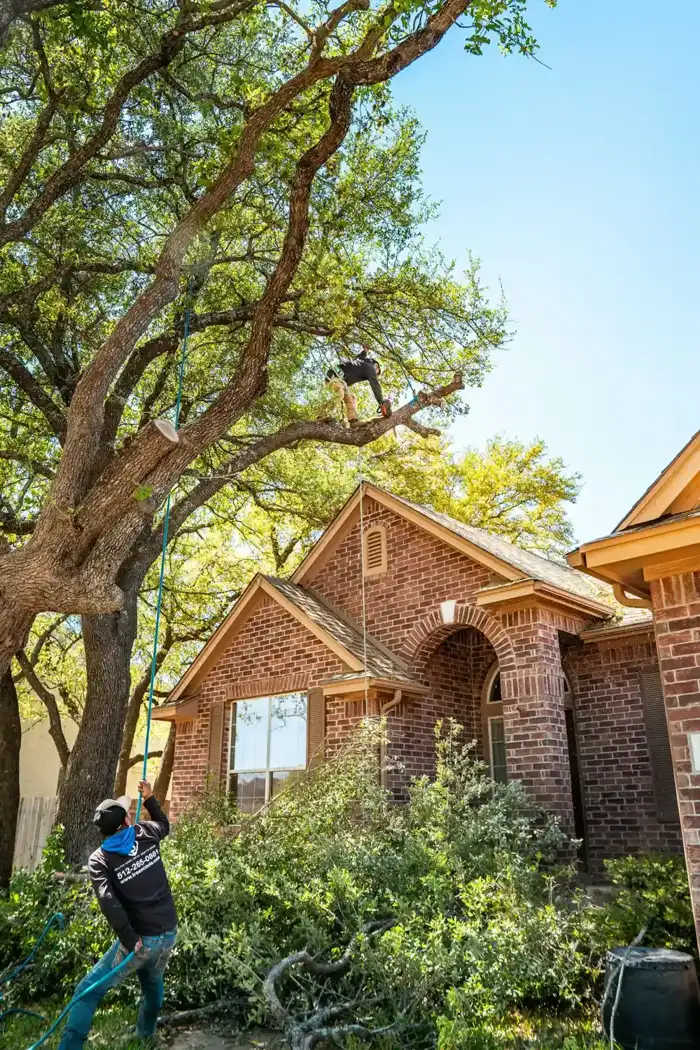
- Roof and chimney clearance. Branches over the roof and near the chimney are cut back, and dead leaves in gutters are a good reason to keep them back.
- Ladder fuel removal. Lower limbs are raised so a ground fire cannot climb into the canopy. A common target is several feet of clearance, or about a third of the tree's height on smaller trees.
- Deadwood and dead fronds. Dead branches and dead palm fronds are removed, since they burn fast.
- Spacing. In Zones 1 and 2, crowded trees may be thinned or removed so canopies are not touching.
- Brush clearing. Dry brush and dead shrubs are cleared, which overlaps with our land and lot clearing work.
Wind, embers and Ontario homes
Ontario's main fire risk for most homes is not a wall of flames but embers carried by Santa Ana winds from fires in the foothills and passes. Embers land in dry palm skirts, piles of leaves against a fence and branches over a roof. That is why Zone 0 and roof clearance matter even on lots in the middle of town, from the older streets around Euclid Avenue to the newer homes in Ontario Ranch. Keeping dead fronds off palms with regular palm tree trimming is one of the simplest steps.
Power lines and fire
Trees in power lines are a known cause of fires. Southern California Edison trims vegetation near its lines and, in high fire risk areas, keeps extra clearance. If any tree on your property is within 10 feet of a line, call SCE at 1-800-611-1911 before anyone works on it. Our guide to trees near power lines explains SCE's process.
Foothill neighborhoods we serve
Defensible space work is most common in our foothill service areas, including Rancho Cucamonga, especially Alta Loma and Etiwanda, and Chino Hills, where the City lists fire defensible space as one reason it may approve removal of a protected tree. Claremont, Upland and La Verne also have homes along the foothills.
How we plan the work
We walk the property with you, measure out roughly where each zone falls and look at every tree and large shrub in it. Then we write an estimate that separates must-do items, such as branches over the roof and dead material, from optional ones, such as thinning a healthy tree. If removal of a protected tree is being considered in a city with tree rules, we tell you to get that city's approval first. Our defensible space zones guide is a good read before the visit.
Keeping it up
Defensible space is not a one-time job. Trees grow, leaves fall and grass dries out every summer. Most owners schedule a check before fire season, usually in late spring, and again before Santa Ana season in the fall. We can set up a regular visit so you do not have to remember.
Common questions
Is defensible space required for my Ontario home?
It depends on whether your property is in a designated fire hazard area. Much of Ontario's valley floor is not, while foothill neighborhoods in nearby cities often are. You can look up your address through CAL FIRE's maps. Even where it is not required, keeping dead vegetation and branches away from the house lowers the risk from wind-blown embers.
What is Zone 0?
Zone 0 is the ember-resistant zone within 5 feet of the house, including under decks. The goal is to keep anything that burns easily away from the walls, such as dead leaves, wood mulch, dry plants and branches hanging over the roof. State rules for Zone 0 are being phased in, so check current CAL FIRE guidance for details.
How high should tree limbs be raised?
The aim is to keep a ground fire from climbing into the canopy, so lower limbs are raised to leave a clear gap above shrubs and grass. A common target on mature trees is several feet, and on smaller trees about a third of the tree's height. We avoid removing so much that the tree is weakened.
Do palm trees need to be trimmed for fire safety?
Dead fronds hanging under a palm's crown are very flammable and can catch embers. Removing dead fronds and seed stalks is one of the most effective fire-safety steps for palms. We leave the healthy green fronds, since over-trimming weakens the palm. Palms near power lines need SCE to be called first.