
CAL FIRE describes defensible space around a home in three zones: Zone 0 from 0 to 5 feet, Zone 1 from 5 to 30 feet, and Zone 2 from 30 to 100 feet or to the property line. Whether the state rules legally apply to a home near Ontario, CA depends on its mapped fire hazard area, so check your address first. Even where they are not required, the same steps reduce the risk from wind-blown embers during Santa Ana fire weather.
Do the rules apply to you?
California's defensible space requirements apply to properties in certain fire hazard areas. Much of Ontario's flat valley floor is outside those areas, while foothill neighborhoods in Rancho Cucamonga, Upland, Claremont, La Verne and Chino Hills are often inside them. Look up your address on CAL FIRE's maps through its defensible space page. If you are in a designated area, your local fire agency may inspect.
Zone 0: 0 to 5 feet
Zone 0 is the ember-resistant zone right next to the house, including under decks. The goal is to keep anything that burns easily away from the walls. Tree work here means:
- Cutting back branches that hang over the roof or touch the walls.
- Keeping gutters and roofs clear of leaves and needles.
- Removing dead plants, wood mulch and debris next to the house.
The state is phasing in detailed Zone 0 rules, so check current guidance from the Board of Forestry.
Zone 1: 5 to 30 feet
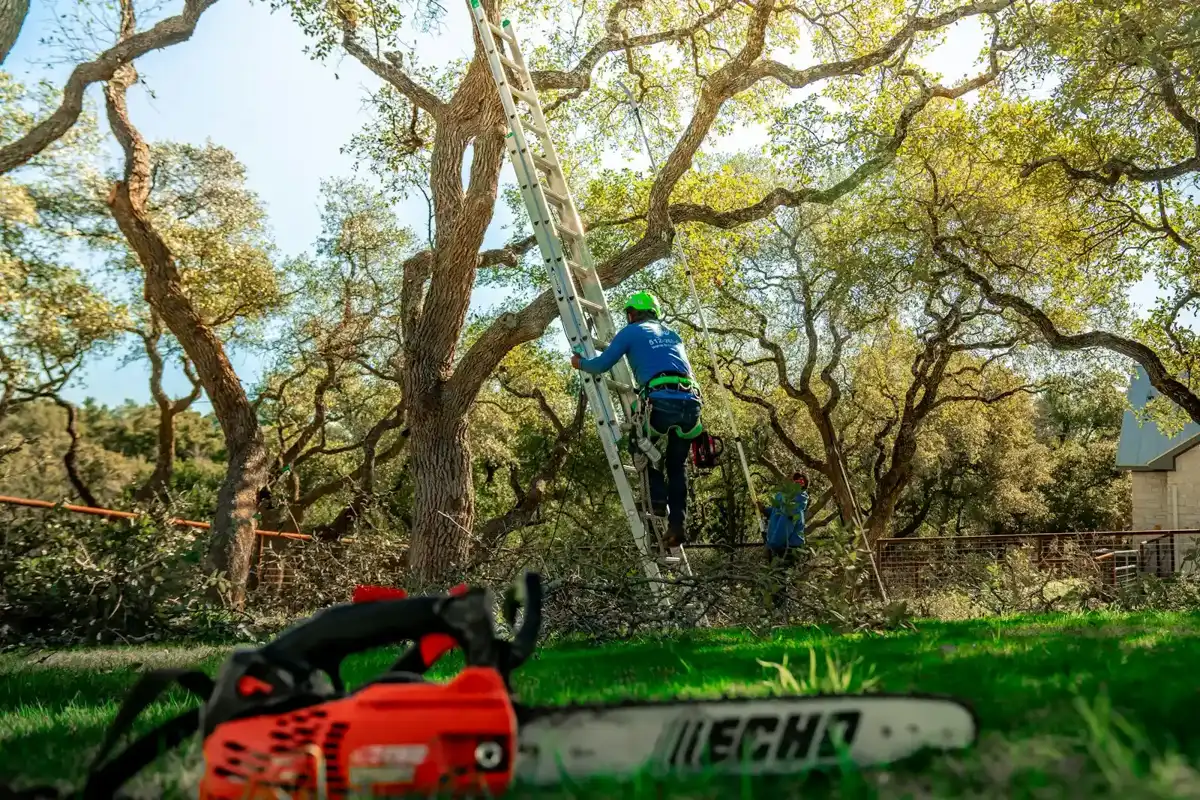
The lean, clean and green zone. Remove dead plants, grass and leaves, keep branches well away from the house and from other trees, and separate shrubs and trees so fire cannot jump from one to the next. Raising lower limbs removes ladder fuels that let a ground fire climb into a canopy.
Zone 2: 30 to 100 feet
The reduced-fuel zone. Keep grass mowed low, remove dead branches and fallen material, and leave horizontal space between shrubs and trees and vertical space between the ground and lower limbs.
Palms and fire
Dead palm fronds are one of the most flammable things in a typical Inland Empire yard. A thick skirt can catch an ember and go up quickly. Removing dead fronds once a year, while leaving the green crown, is one of the simplest fire-safety steps. See our palm trimming schedule.
Embers and the valley floor
Most homes in Ontario are not next to wildland, but embers can travel long distances in Santa Ana winds from fires in the foothills and passes. Embers land on roofs, in gutters, in dry palm skirts and in piles of leaves against fences. That is why Zone 0 work matters even in neighborhoods near Ontario's Downtown and Euclid Avenue corridor, far from the hills.
Trees and power lines
Trees in lines can spark fires. Never trim near a line yourself. Call SCE at 1-800-611-1911, and read our post on trees near power lines.
Getting it done
We do defensible space tree work and land and lot clearing across Ontario and the foothill cities. If protected trees are involved, such as oaks in La Verne or native trees in Chino Hills, get the city's approval first. Call (909) 479-2614 to schedule a walk-through.
Fences and outbuildings
Wood fences act like a wick that carries fire to the house. Keep the first few feet of fence nearest the house clear of dry plants and debris. Sheds, wood piles and propane tanks need their own clearance too, so keep brush and low branches away from them.
Start with the zone closest to the house, since that is where embers do the most harm.
Common questions
How often should defensible space be maintained?
At least once a year, before fire season, and again before Santa Ana season in the fall. Grass grows back, leaves fall and branches grow toward the roof every year. Many owners schedule a spring cleanup and a fall check so the zones around the house stay clear.
Do I have to remove trees for defensible space?
Usually not. Most defensible space work is pruning, spacing and removing dead material. Healthy, well-spaced trees with lower limbs raised and branches off the roof can stay. Removal may make sense for dead trees or crowded trees touching the house. Protected trees need city approval first.